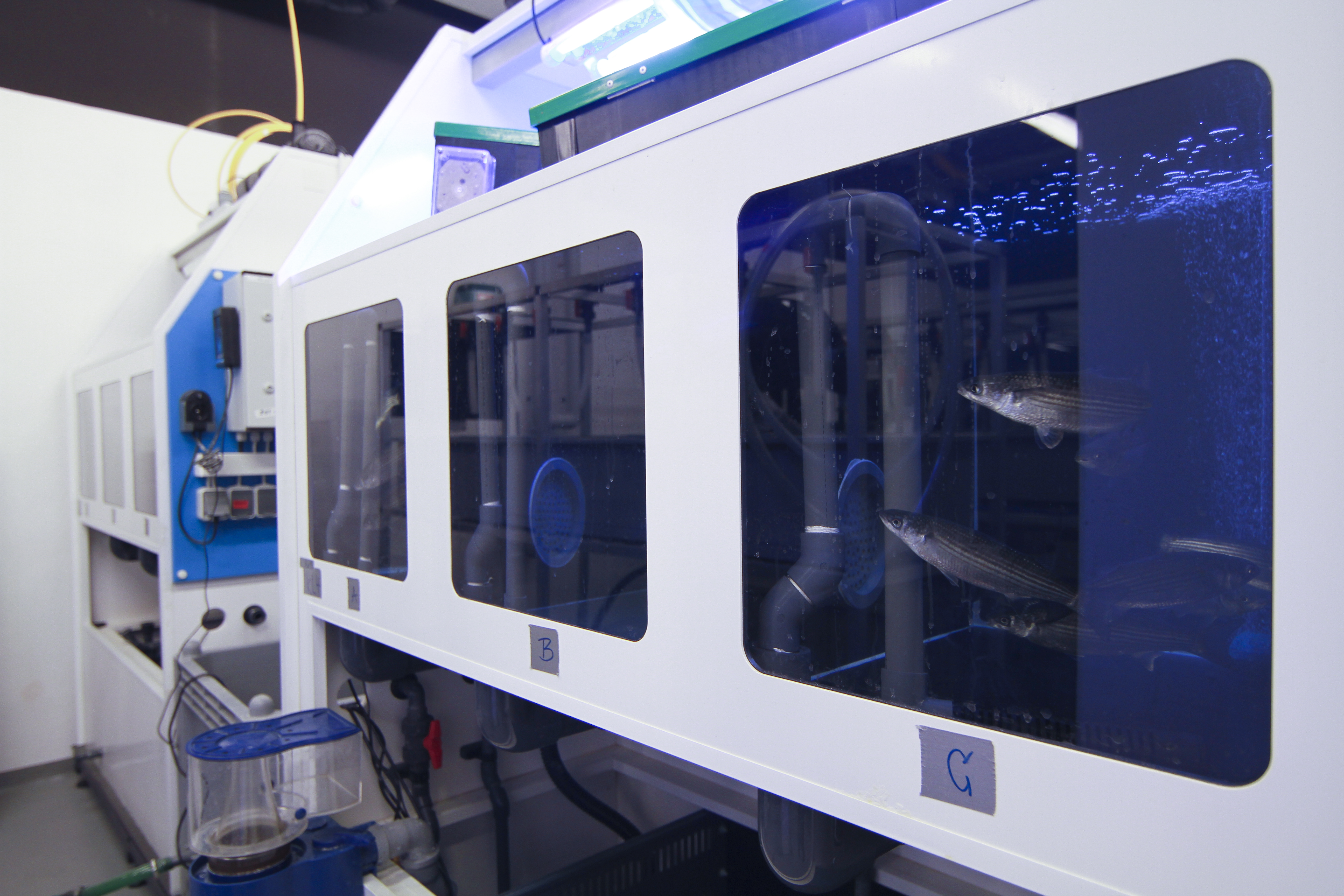
Experimental Aquaculture Systems

Would you like to work with us on innovative aquaculture systems?
Contact us for collaborations and joint projects.

Profile of the Group

The Experimental Aquaculture Systems group develops, operates, and validates modern recirculating aquaculture systems (RAS) for research and industry.

Our experimental facilities enable controlled, reproducible, and scalable studies—from biological experiments to technological pilot-scale testing. We combine biological research questions with application-oriented system development. Through standardized processes, continuous monitoring, and comprehensive data collection, we create a reliable foundation for the development of new technologies, components, and process strategies.

Together with industry and research partners, we transfer scientific findings into practical solutions. This results in aquaculture systems that enable safe water quality, efficient resource use, and reliable operation in both research and industrial environments.

Research Areas

We develop and optimize modular recirculating aquaculture systems (RAS) that precisely reflect species-specific requirements and enable reliable, scalable experimental conditions.

Our culture systems combine biological research questions with technical system development and create reproducible, industry-oriented environments for research and pilot-scale testing.

Based on the biological requirements of the target species, we derive technical specifications, implement them at semi-industrial scale, and validate new system concepts under realistic conditions. This results in flexible test platforms for the development of technologies, components, and husbandry strategies.

Focus areas:

  • Development and validation of RAS concepts for different species
  • Design and optimization of key water treatment components
  • Integration of demand-oriented measurement, control, and automation technology
  • Derivation and assessment of species- and process-specific husbandry strategies
  • Validation in a semi-industrial environment to ensure practical applicability and scalability


We develop and optimize water treatment and system hygiene processes to ensure stable, safe, and scalable operations in closed recirculating aquaculture systems (RAS).

Closed systems place high demands on the removal of metabolic waste products, the stabilization of microbial processes, and the prevention of hygiene-related risks.

Our research combines modern system design, integrated treatment concepts, precise monitoring, and targeted hygiene measures. In this way, we create robust process conditions for research, pilot-scale trials, and industrial applications—from biofiltration to innovative sanitation methods.

Focus areas:

  • Optimization of treatment stages for the removal of solids, dissolved substances, and microbiological loads
  • Improvement of nitrifying and denitrifying biofiltration for stable nitrogen conversion
  • Development and integration of innovative sanitation methods (e.g. laser-based cleaning and disinfection techniques)
  • Monitoring of relevant water quality parameters for real-time surveillance and process stabilization
  • Analysis of biofilms and microbial activity to identify potential risks
  • Development of adaptive process strategies for minimal water consumption and maximum system stability

We identify efficient material cycles and resource-optimized processes for modern aquaculture systems.

Recirculating aquaculture systems (RAS) offer strong potential for the sustainable use of water, energy, and nutrients. Our research focuses on unlocking these resources strategically along the aquatic bioeconomy and converting them into new value creation pathways.

We analyse and optimize nutrient and residual material flows, develop circular concepts for the reuse of water and nutrients, and investigate coupling potentials within the aquaculture sector. This results in scalable, resource-efficient, and ecologically robust approaches for future aquaculture systems.

Focus areas:

  • Development of waste-to-feed and resource recovery strategies
  • Water reuse concepts to reduce freshwater demand
  • Development of compact pilot-scale RAS for urban spaces and short value chains
  • Analysis of coupling potentials within the aquaculture sector
  • Identification of new value creation pathways along the aquatic bioeconomy

Services of the Group

We operate recirculating aquaculture systems (RAS) at experimental and pilot scale, enabling controlled, reproducible, and industry-relevant conditions for biological and technological research questions.

Our standardized processes, measurement concepts, and documented procedures provide a reliable basis for robust studies – from basic experiments to EFSA-compliant trials.

  • Provision of controlled and scalable RAS environments (hydraulics, water chemistry, temperature, lighting/photoperiod, biosecurity)
  • Reproducible experimental execution through uniform standards and established protocols
  • Support in experimental design, parameter selection, and study planning
  • Flexible test environments for component development, system optimization, process analytics, and biological performance parameters
  • Comprehensive monitoring (including O₂, temperature, pH, redox, conductivity, turbidity)
  • Alarm management, defined threshold logic, and documented process control for safe operations
  • Complete documentation of all biological and technical performance indicators (growth, FCR, survival, water quality stability, system performance, energy and water consumption, operational inputs)
  • Possibility to conduct EFSA-compliant studies with defined control parameters, feeding regimes, and standardized environmental conditions

Equipment – Aquaculture and Aquatic Resources

Our experimental facilities form the technical foundation for reproducible, scalable, and industry-oriented experiments. They enable controlled studies at small, medium, and semi-industrial scale and are modularly expandable. The infrastructure allows flexible experimental scenarios – ranging from biological studies and component and technology testing to system optimization.

  • 18 individual recirculating systems of 750 liters each (currently under construction)
  • 30 circular tanks of 250 liters with a central water treatment system (currently under construction)
  • Six individual recirculating systems of 1.5 m³
  • Four connectable recirculating systems (4×3 tanks of 500 liters each)
    Three incubation trough systems
  • Six aquarium systems with 10–60 tanks (50–300 liters)

Applications:

  • Scalable biological experiments (growth, physiology, behavior)
  • Test environments for components, sensor systems, automation, and process engineering
  • System validation under realistic condition
  • Comparative and parallel experiments through modularly designed recirculating systems

For the assessment of biological, chemical, and microbiological process parameters, a comprehensive analytics and measurement technology infrastructure is available. It enables precise monitoring of water quality as well as well-founded analysis of biological performance parameters and technological components in recirculating aquaculture systems (RAS).

Sensors & real-time monitoring
  • Handheld probes for key water quality parameters (O₂, CO₂, TGP, pH, redox, conductivity, salinity, turbidity)
  • Sensor-based monitoring systems for continuous real-time measurements and automated process control
Chemical analysis
  • TOC/TN analyzer for determining organic and inorganic carbon and nitrogen fractions
  • Photometer for comprehensive inorganic and organic water chemistry
Biological & microbiological analyses
  • BSB measurement systems for the analysis of biological degradation processes
  • Method for determining microbial activity in water
specialized analytics
  • Off-flavor analysis (GC-MS) for the identification of taste-relevant substances in fish and process water